House Passes Amata-Backed Bipartisan Ocean Monitoring Bill
Washington, D.C. – Congresswoman Uifa’atali Amata is hailing House passage of a bill she co-led to update and reauthorize the Integrated Coastal and Ocean Observation System Act for five fiscal years with funding at $56 million yearly. This bill would authorize, modernize, and fund the public-private partnership of coastal observation systems collecting data to inform decision-making along our nation’s extensive coasts and in marine waters.
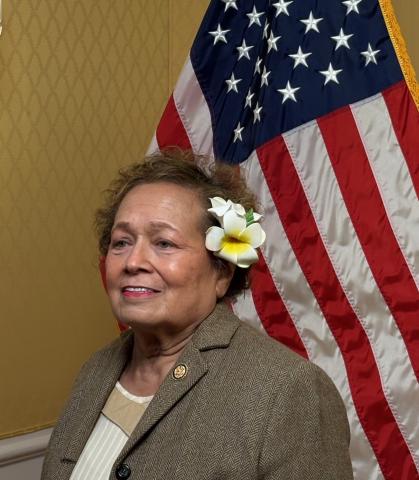
Congresswoman Amata earlier this month in the US Capitol
Congresswoman Aumua Amata was part of the group of six Members of Congress, known as original cosponsors, working together at introduction of this bill, H.R. 2294, in March 2025, which was led by Rep. Mike Ezell (R-MS), with Congresswoman Amata (American Samoa), Rep. Bonamici (D-OR), Rep. Weber (R-TX), Rep. Dingell (D-MI), and Rep. Davis (D-IL). Their bipartisan bill has since advanced through the House Natural Resources Committee with legislative hearings and votes, where Amata and several of these Members serve. The bill now requires Senate passage to become law.
“Well-situated ocean observations provide data that can save lives and improve maritime decisions, as well as considerations for fisheries and coastal areas, and strengthen tsunami response and environmental health,” said Congresswoman Amata. “American Samoa and many other communities on the U.S. coast benefit from these ocean monitoring services that help our scientists know our ocean better.”
The bill provides ongoing and future support for critical ocean monitoring efforts that protect coastal communities, fisheries, and maritime industries.
In addition to reauthorizing, the legislation will improve the program’s effectiveness by clarifying the type of data it provides as operational oceanographic information; updating statutory references to reflect current law, including replacing the National Ocean Research Leadership Council with the Ocean Policy Committee; and enhancing the role of the Interagency Ocean Observation Committee to ensure the program is used to its full capacity as an integrated system.
“In American Samoa, we have a buoy that gathers ocean information that is named in honor of our longtime Port Director Chris King,” said Congresswoman Amata. “Data gathered here can help planners elsewhere, and in turn data on the other side of the Pacific can prove beneficial far away through integrated analysis.”
House Passes Natural Resources Bills for Parks and Forests
The House also passed a slate of 12 bills from the Natural Resources Committee, focused on specific protections, reforms, improvements, services, and restoration efforts at national parks and forests. These House-passed bills await Senate passage.
These include the Save Our Sequoias (SOS) Act, led by Rep. Vince Fong (R-CA). This bipartisan bill builds on efforts in the prior Congress that Amata cosponsored to protect giant sequoias from wildfires, disease, and drought. The updated bill includes reforestation and a multi-year emergency declaration for the threatened area. Nearly 20 percent of giant sequoias were lost to wildfire devastation in just the years 2020-2022.
Other passed bills support restoration efforts at Grand Canyon National Park, create the Chiricahua National Park in Arizona, authorize the Department of the Interior to carry out priority reforestation projects following disasters, extends the National Emergency Medical Services (EMS) Memorial Foundation’s efforts over the next seven years for a memorial to fallen EMS personnel, and authorizes the Secretary of Agriculture to convey small parcels of federal land for cemeteries through the Small Cemetery Conveyance Act.
###